 WAWG
WAWG
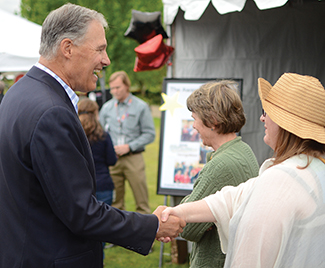
Gov. Jay Inslee is running for re-election. Photo courtesy of the Governor’s Office.
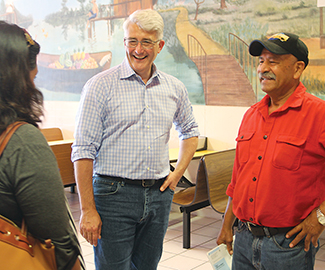
Challenger Bill Bryant (center) is a former King County port commissioner. Photo courtesy of the Bill Bryant Campaign.
Editor’s note: Sometimes, elections seem to be a remote thing that just happens and is unconnected to agriculture. Not this year. With the 2018 Farm Bill peeping over the horizon, the choices Washington wheat farmers make in November could impact their livelihood far beyond the next two to four years. While most of the farm bill action will take place in Washington, D.C., the influence our state lawmakers have over that process shouldn’t be pushed aside. In just a few weeks, we’ll choose who will speak for us and who we’ll trust to fight for our best interests, from the newest city councilmember to the state commissioner of public lands to our federal delegation. Right smack in the middle of this is the governor’s race. On one side is democratic incumbent Jay Inslee. On the other side is former King County port commissioner, republican Bill Bryant. We reached out to both candidates and asked them to explain their positions on issues we think are important to wheat farmers. Both candidates were sent the same set of questions at the same time. Below are their responses. In an effort to keep this as impartial and fair as possible, we have not edited for content.
As Governor, what will you do to keep exports moving smoothly through Washington’s ports?
Bryant: As King County port commissioner, my job was to keep Washington’s ports open and growing. I know that over a third of our state’s economy crosses our ports and how important it is to grow and retain solid, family wage jobs in Washington. First and foremost, I will make freight mobility and reducing traffic congestion the top priority of the Dept. of Transportation. The biggest obstacle to our competitiveness right now is limited freight corridors and congested roads that are severely hurting our ability to move goods to market.
I will also be a uniting and pacifying leader when it comes to labor relations. I have a healthy relationship with our state’s labor unions and would use this positive history to divert or alleviate negotiations that might harm the flow of goods through our ports. I have been pushing ILWU and terminal operators to finalize a new contract before the current one expires and we endure another standoff.
Inslee: The ports slowdown is still fresh in many peoples’ minds. It resulted in substantial economic losses and created problems with our overseas trading partners. Labor/management issues are complex and the Governor’s Office and state government in general must be impartial regarding such matters. I will, however, provide leadership to avoid disruptions in the operations of our ports whenever it is appropriate for me to do so in my role as governor.
Agriculture is an energy-intensive industry, and volatile prices significantly affect the cost of growing crops. How will you balance energy regulations that raise the cost of growing crops against farmers’ ability to grow food and make a living?
Inslee: Climate change is having a significant effect on Washington’s agricultural industry, especially when it comes to the availability of water needed to support irrigated agriculture. It is important that we take bold steps to address that threat so that the devastating 2015 drought won’t portend our future.
My energy proposal is intended to limit releases of carbon and other greenhouse gases that contribute to climate change. It does not include additional taxes on fuels that are needed for growing crops. Additionally, we are incredible lucky to enjoy an abundance of clean hydropower in this state, and I believe by integrating increases in solar and wind energy into the mix of energy options we have a great opportunity to improve our energy supply and even provide additional income for wheat farmers.
With all that in mind, I recognize that Washington’s agricultural industry is already making significant contributions to reductions in fossil fuel use. The high level of efficiency of Washington agriculture is demonstrated by the extraordinary productivity per acre being achieved on some of our farms. I continue to marvel at the innovative spirit of our farmers and agricultural industry organizations in fostering that efficiency.
Bryant: Washington already has some of the strictest environmental regulations and the highest gas taxes in the nation. With many farmers already operating on slim margins, a fluctuation in energy costs can be the close of business. New fuel standards, carbon taxes or emissions standards will have marginal environmental benefit and threaten agricultural jobs. I will not support any increases that hurt middle class jobs with no benefit to the environment.
The Washington wheat industry relies heavily on the state’s transportation system to move their product to market. As Governor, how will you maintain and improve our roads and railways?
Bryant: First, I will make increasing freight mobility and reducing traffic jams a priority for the Dept. of Transportation and hold them accountable to it. Our port connections will be completed within three years as governor and I will work to add capacity where needed to keep trucking corridors moving to ensure our crops get to market. With 30 years of experience in trade and exports, I understand just how essential it is that we have an efficient truck, rail and barge system.
Inslee: International and national trade flows through our Puget Sound and Columbia River ports. That’s why I was so proud to secure the 2015 transportation package that included critical investments in major corridors across the state, including nearly $2 billion to complete the SR 167/509 routes to the Ports of Tacoma and Seattle. Additionally, working with our state Department of Transportation and industry partners, we continue to make improvements in the I-5 and I-90 corridors to gain operational efficiencies. We have been building grade separations to facilitate rail shipments and have been evaluating potential public investments in additional intermodal facilities. It is also worth noting that our department of transportation owns and operates the Palouse River and Coulee City Railroad which serves the heart of wheat country and makes delivery of wheat to the class I railroads.
What is your position on breaching the Snake River dams?
Inslee: My administration supports hydropower and salmon recovery, which is why Washington was supporting the Biological Opinion (BiOp) for the federal hydropower system that has been in place since 2014. In May of this year a federal judge overturned that BiOp and in his ruling has required that the federal government study dam breaching during the next five years as a possible alternative for saving Columbia and Snake River salmon.
I have not proposed breaching the dams, but I don’t think the federal government has a choice about whether to do the study, so I will be focused on making sure that it fully considers the costs and benefits of such a dramatic action, and at the same time pushing for a comprehensive review of other possible actions that might promote healthy salmon runs while maintaining our hydropower system for energy, navigation and other uses.
Bryant: I do not support breaching the Snake River dams.
Many producers feel unfairly targeted by clean air and water regulations. How would you address those farmers’ concerns that they are overly burdened with regulations despite doing everything they can to address air/water issues?
Bryant: I’ve been all across the state hearing from people with the same concern and I get it. That’s why on day one as governor, I will place a moratorium on any new state regulations until we can either justify or eliminate the ones we already have. Our farmers and agricultural producers are the frontline in interacting with the environment and I will look for their help in identifying regulations that are holding production back. I am already accepting submissions of regulations for review. Producers are welcome to send me their ideas right now to
regs@billbryantforgovernor.com.
Inslee: The citizens of Washington demand clean air and clean water, thus, I take the responsibility for protection of our natural resources very seriously. However, I do recognize that the multi-level, regulatory framework faced by our farmers is complex and often difficult to negotiate. That framework coupled with the need to comply with industry driven certification programs can be frustrating for farmers.
I have insisted that our state regulatory agencies coordinate and streamline their activities to eliminate conflicting or duplicative requirements and to, as much as possible, base regulatory requirements on local conditions. It is also essential for our agencies to coordinate with federal and local regulatory agencies to achieve similar types of streamlining. Providing technical assistance and funding to assist farmers in achieving compliance is a high priority for me.
Through the state’s natural resource agencies, I am encouraging the development of collaborative, incentives based programs such as the state’s new Voluntary Stewardship Program. Specifically within wheat country, I am impressed by the progress being made through the Palouse and Spokane Conservation Districts’ Regional Conservation Partnership Programs in reducing sedimentation in area streams.
How can the Governor’s office help the state’s agricultural industry grow?
Inslee: As the population of our state, our nation, and the world increases, Washington’s agricultural industry will continue to rise in importance. I am working hard to provide an environment for our agricultural industry to grow and prosper.
Improving the efficiency of our transportation corridors, finding and maintaining adequate water supplies, and keeping productive agricultural lands in farming are all important priorities for me. I also recognize the importance of establishing and maintaining good relationships with our foreign trading partners. During my first term, I sponsored several overseas trade missions, including our most recently mission to Korea and Japan where I had an opportunity to showcase our high quality agricultural products. I intend to continue sponsoring such important missions during my second term. In addition, my staff routinely collaborates with the state Departments of Commerce and Agriculture regarding ongoing trade promotion activities.
Bryant: I love this question because for 30 years I’ve been working to grow Washington’s agricultural industry, both in the private and public sector. Now, I want to bring these skills and this passion to the governor’s office. First, I will be an ambassador for Washington crops across the nation and the world. But secondly, I will not ignore the problems at home and will use my power as governor to reduce or eliminate the transportation problems that are holding Washington exports back. By putting a halt to new regulations and completing a full regulatory review we can build a fair regulatory system that works with our agricultural industry, not against it.
This requires a governor who gets it and is willing to roll up his sleeves to fix the problems. That’s what I will bring to the office.
Why should Washington wheat farmers vote for you?
Bryant: No one will appreciate your challenges and opportunities more than I will in this race. After 30 years experience in growing Washington exports from apples to hops to wine to wheat, I’ve made it my career getting crops to markets. As port commissioner, I delivered on this commitment, uniting the ports of Seattle and Tacoma to increase our ability to compete on a global scale. As governor, I will get traffic moving again and restore common sense to state regulations. I understand the damage of the last four years with a governor more focused on social engineering than growing Washington’s economy and I understand what you need to grow and succeed. Let me give you a voice in the governor’s office for the first time in a long while.
Inslee: As Governor, I am working to build a stronger economy and better future for our state. I believe that we can have clean air, clean water, and have a vibrant economy. And, I will continue to support and be the chief advocate for Washington agriculture at home and abroad to grow your industry.
What is your favorite wheat-based food?
Inslee: My number one favorite is bread. Every kind there is, I absolutely love it.
Bryant: Grandma’s cinnamon rolls!