 WAWG
WAWG
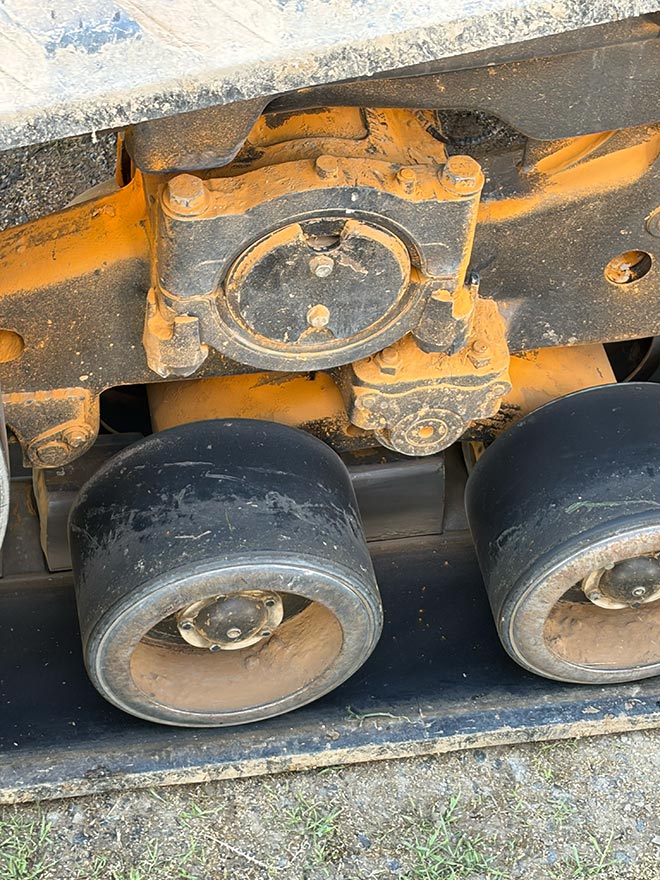
Evidence of stripe rust on a tractor tracks in Franklin County. Photo by Andrea Cox.
By Dr. Xianming Chen
USDA-ARS
Since the last update on March 19, stripe rust of wheat has been developing fast in the Pacific Northwest, and many winter wheat fields have been applied with fungicides at the herbicide timing. We have been planting spring cereal nurseries and collecting stripe rust data from winter nurseries at some of the experimental fields.
On April 9, we were planting spring nurseries and taking stripe rust notes at Central Ferry in Garfield County. Plants were at Feekes 7 to 9, and stripe rust reached 100% incidence and 80% severity on the middle canopy and appeared on top leaves on susceptible varieties.
On April 14 and 15, we were planting spring nurseries and taking winter nursery notes at Mount Vernon in Skagit County. Plants were at Feekes 5 to 6, and stripe rust reached 60-80% severity. For this location, the plant growth stage and stripe rust level were normal.
On April 16, we checked some commercial fields in the Horse Heaven Hills region in Benton County and found one field with stripe rust over 60% incidence and 20-60% severity. This field appeared not sprayed with fungicide.
On April 16, we took notes in the winter wheat stripe rust monitoring nurseries planted by Dr. Ray Qin’s group at the Oregon State University Hermiston Agricultural Research & Extension Center in Umatilla County, Ore. Plants were at Feekes 5 to 7, and stripe rust reached 60% severity on susceptible varieties. In our experimental field at Walla Walla in Walla Walla County, stripe rust also reached 60% severity on susceptible varieties.
On April 21, I was checking winter wheat fields in the Palouse region in Whitman County, Wash., and Latah County, Idaho. Wheat plants ranged from Feekes 5 to 7. Stripe rust was not found in commercial fields but was found on goat grass at the edge of a wheat field in Idaho. In our experimental fields around Pullman, Wash., stripe rust reached quite uniform throughout the field. The fungus produced more spores on the low leaves but reached the top leaves. The disease has developed fast since the last report a month ago.
Stripe rust was found on barley plants in the experimental fields at various locations and reached 60% severity on susceptible varieties at Central Ferry and Mount Vernon.
As the weather conditions forecast for the next 10 days will continue to be favorable for stripe rust, the disease pressure will likely increase. The previous recommendations (https://striperust.wsu.edu/2026/03/05/stripe-rust-forecast-and-update-march-4-2026/) are valid. Varieties with stripe rust ratings of 3 to 9 need fungicide application at the time of herbicide application. A second application may be needed, especially for varieties with stripe rust ratings of 5 to 9. Please start rechecking fields about 20 to 30 days after the first application. If active stripe rust appears in the field, second fungicide application should be done before rust incidence reaching 5% on flag leaves.
Stripe rust in the country
So far, stripe rust has been reported in Washington, Oregon, California, Texas, Oklahoma, Louisiana, Mississippi, and Tennessee. Contrast to the high pressure of stripe rust in the Pacific Northwest, the stripe rust pressure is relatively low in the southcentral Great Plains and southeastern states. For detailed information of stripe rust and other rusts in various states, please check the recent Cereal Rust Bulletin (https://www.ars.usda.gov/ARSUserFiles/50620500/CRBs/2026 CRB April 13.pdf).